Average Age to Have a Baby New Zealand
What separates Generation Y from 10? And hey Gen Z and Gen A, welcome to the party! What'due south the cutoff? How sometime is each generation? Are they actually that different?
It'due south easy to see why at that place is and then much confusion about generational cohorts.
If y'all've ever felt muddled by this "alphabet soup" of names — y'all're not alone. The existent frustration hits when yous realize that Millennial consumers represent the highest-spending generation in 2020 — with a projected $1.4 trillion tab.
And though their current wealth has been dragged downwards by not one just two "in one case-in-a-lifetime" economic crises during their near impactful career years, Millennials stand to inherit over $68 trillion from Baby Boomer and early Gen X parents by the year 2030, setting them up to potentially be the about wealthy generation in U.S. history.
Generation Z isn't far backside, projected to hit $33 trillion in income by 2030 — that'due south more than a quarter of all global income — and pass Millennials in spending power the year after. three
And coming up last merely not to the lowest degree is Generation Alpha, the proper name given by social analyst Marking McCrindle to the youngest children on the planet. Past the yr 2025 in that location will be nearly 2 billion members of Generation Alpha across the earth.
No matter how you piece the data, the younger generations have never been more than disquisitional to your fiscal establishment's time to come.
Unless you understand who they are and what they want, you lot won't capture a dollar of their money.
People grow older. Birthdays stay the same.
A mutual source of confusion when labeling generations is their age. Generational cohorts are defined (loosely) by nativity yr, not current age. The reason is simple — generations get older in groups. If you think of Millennials equally college kids (eighteen - 22), then not only are you out of date — yous're thinking of a stage in life, not a generation. Millennials are at present well out of college, and that life stage is dominated by Gen Z.
Another example, a member of Generation X who turned xviii in 1998 would at present be over xl. In that fourth dimension, he or she cares about vastly unlike problems and is receptive to a new fix of marketing letters. Regardless of your historic period, you volition ever belong to the generation you were born into.
The breakdown by age looks like this:
-
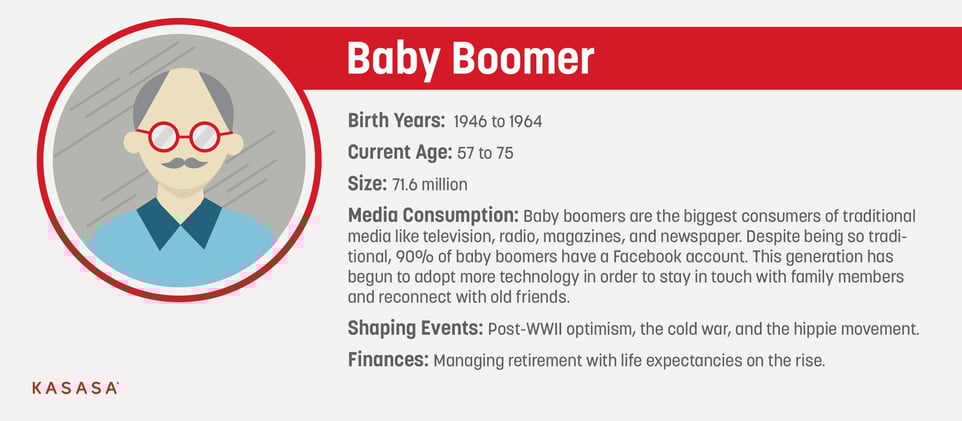
Baby Boomers: Babe boomers were born between 1946 and 1964. They're currently between 57-75 years old (71.6 meg in the U.S.)
-
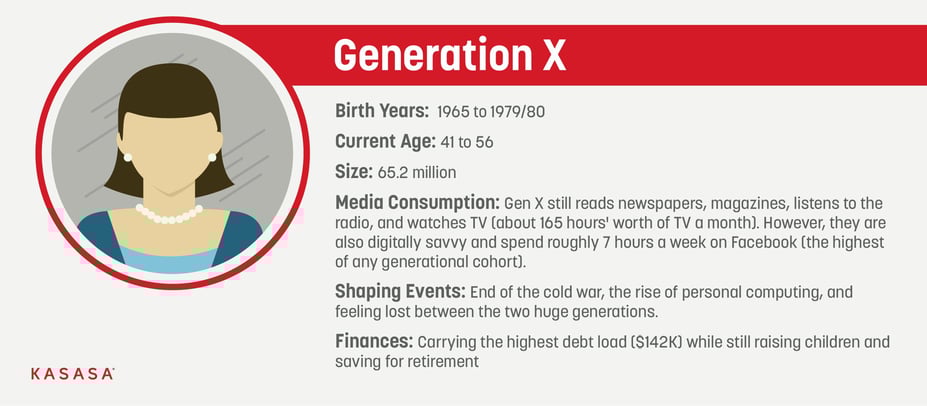
Gen X: Gen X was born between 1965 and 1979/80 and is currently between 41-56 years old (65.two million people in the U.S.)
-
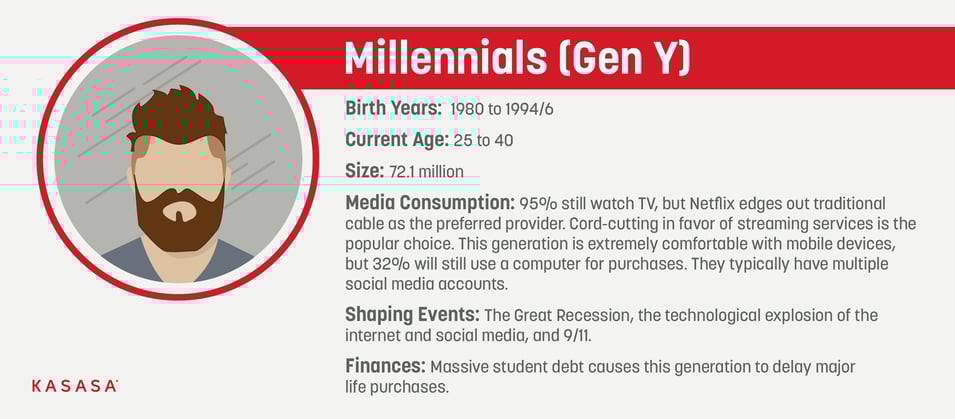
Gen Y: Gen Y, or Millennials, were born between 1981 and 1994/6. They are currently betwixt 25 and 40 years erstwhile (72.1 million in the U.Due south.)
-
Gen Y.1 = 25-29 years old (around 31 meg people in the U.Due south.)
-
Gen Y.2 = 29-39 (around 42 one thousand thousand people in the U.South.)
-
-
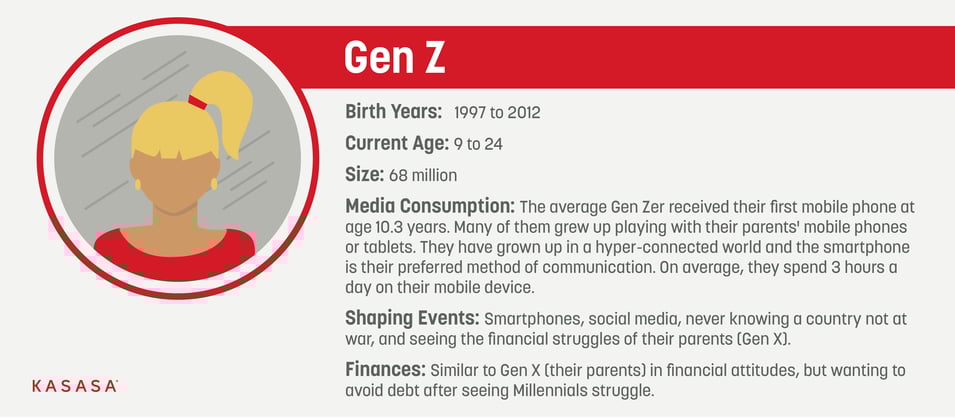
Gen Z: Gen Z is the newest generation, born between 1997 and 2012. They are currently betwixt 9 and 24 years old (nearly 68 one thousand thousand in the U.S.)
-
Gen A: Generation Blastoff starts with children built-in in 201 2 and will c ontinue at least through 2025, possibly subsequently (approximately 48 million people in the U.Due south.)
The term "Millennial" has become the popular style to reference both segments of Gen Y (more on Y.one and Y.2 below).
Sometimes labeled with the moniker "Zillennials", those wedged at the tail end of Millennials and the start of Gen Z are sometimes labeled with this moniker — a grouping made up of people built-in betwixt 1994 and the year 2000.
Originally, the name Generation Z was a placeholder for the youngest people on the planet — although Generation A has now taken over that distinction. However, in the aforementioned way that Gen Y morphed into Millennials, there is certainly a possibility that both Gen Z and Gen A may adopt new names equally they leave boyhood and mature into their adult identities. While the characterization Gen A makes discussion easier, information technology may non be the last discussion on this group of humans.
Why are generations named after letters?
Information technology started with Generation X, people born betwixt 1965-1980. The preceding generation was the Infant Boomers, born 1946-1964. Mail-Globe War Two, Americans enjoyed newfound prosperity, which resulted in a "baby boom." The children born as a consequence were dubbed the Babe Boomers.
But the generation that followed the Boomers didn't take a breathy cultural identifier. In fact, that's the anecdotal origin of the term Gen Ten — illustrating the undetermined characteristics they would come to be known by. Depending on whom you inquire, information technology was either sociologists, a novelist, or Billy Idol who cemented this phrase in our vocabulary.
From there on it was all downward-alphabet. The generation post-obit Gen X naturally became Gen Y, born 1981-1996 (requite or have a few years on either end). The term "Millennial" is widely credited to Neil Howe, along with William Strauss. The pair coined the term in 1989 when the impending turn of the millennium began to characteristic heavily in the cultural consciousness.
Generation Z refers to babies built-in from the late 90s through today. A flurry of potential labels has likewise appeared, including Gen Tech, mail-Millennials, iGeneration, Gen Y-Fi, and Zoomers.
While some say Generation Alpha is named for the first letter of the Greek alphabet and denotes the first of a series of items or categories, Generation Alpha may also just exist an piece of cake way to round the corner into a new alphabet.
Splitting up Gen Y
Javelin Enquiry noticed that not all Millennials are currently in the same stage of life. While all Millennials were built-in effectually the turn of the century, some of them are still in early adulthood, wrestling with new careers and settling down, while the older Millennials have a dwelling house and are building a family. You can imagine how having a child might change your interests and priorities, so for marketing purposes, it's useful to split this generation into Gen Y.1 and Gen Y.2.
Not merely are the two groups culturally different, merely they're in vastly dissimilar phases of their financial life. The younger group is merely at present flexing their buying ability. The latter group has a more than all-encompassing history and may exist refinancing their mortgage and raising children. The contrast in priorities and needs is stark.
The same logic can be applied to any generation that is in this stage of life or younger. As nosotros get older, we tend to homogenize and face up similar life issues. The younger we are, the more dramatic each stage of life is. Consider the difference between someone in elementary school and loftier school. While they might be the same generation, they take very different views and needs.
Marketing to immature generations as a single accomplice will not be nearly every bit effective as segmenting your strategy and messaging.
Why are generation accomplice names of import?
Each generation label serves as a shorthand to reference nearly 20 years of attitude, motivations, and historical events. Few individuals self-place as Gen X, Millennial, or any other name.
They're useful terms for marketers and tend to trickle down into common usage. Again, it'south important to emphasize that referring to a accomplice only by the age range gets complicated quickly. X years from at present, the priorities of Millennials will take changed — and marketing tactics must adjust instep. There are also other categories of cohorts you can employ to better understand consumers going beyond age or generation.
Recollect, these capricious generational cutoff points are merely that. They aren't an exact science and are continually evolving.
Whatever terminology or grouping you use, the goal is to reach people with marketing letters relevant to their phase of life. In brusk, no matter how many letters get added to the alphabet soup, the most important thing y'all tin can do is seek to understand the soup du jour for the blazon of consumer you want to attract.
What makes each generation different?
Earlier nosotros dive into each generation, remember that the exact years born are in dispute, because there are no comparably definitive thresholds past which the subsequently generations (afterwards Boomers) are defined. Only this should give you a general range to help identify what generation you vest in.
The other fact to remember is that new engineering is typically beginning adopted by the youngest generation and then is gradually adopted by the older generations. As an example, 96% of Americans have a smartphone, but Gen Z (the youngest generation) is the highest user.
The Baby Boomer Generation
-
Boomer Birth Years: 1946 to 1964
-
Current Historic period: 57 to 75
-
Generation Size: 71.6 million
-
Media Consumption:Babe boomers are the biggest consumers of traditional media like television, radio, magazines, and newspaper. Despite being so traditional, xc% of baby boomers take a Facebook account. This generation has begun to prefer more than technology in order to stay in impact with family members and reconnect with erstwhile friends.
-
Banking Habits: Boomers adopt to go into a branch to perform transactions. This generational cohort still prefers to use greenbacks, especially for purchases under $5.
-
Shaping Events:Post-WWII optimism, the cold war, and the hippie motion.
-
What's next on their financial horizon: This generation is experiencing the highest growth in student loan debt. While this might seem counterintuitive, it can exist explained by the fact that this generation has the most wealth and is looking to aid their children with their student debt. They have a belief that you should take intendance of your children enough to set them on the right course and don't plan on leaving any inheritance. With more Americans outliving their retirement fund, failing pensions, and social security in jeopardy, ensuring you can successfully fund retirement is a major concern for Boomers.
Generation X
-
Gen 10 Birth Years: 1965 to 1979/80
-
Current Historic period: 41 to 56
-
Other Nicknames: "Latchkey" generation, MTV generation
-
Generation Size:65.2 1000000
-
Media Consumption:Gen X still reads newspapers, magazines, listens to the radio, and watches TV (about 165 hours' worth of Television a month). However, they are also digitally savvy and spend roughly 7 hours a week on Facebook (the highest of any generational accomplice).
-
Cyberbanking Habits:Since they are digitally savvy, Gen X will do some research and financial management online, but still adopt to do transactions in person. They believe cyberbanking is a person-to-person business and demonstrate make loyalty.
-
Shaping Events: End of the cold war, the ascent of personal computing, and feeling lost between the 2 huge generations.
-
What'southward adjacent on Gen X's financial horizon: Gen Ten is trying to raise a family unit, pay off student debt, and take care of aging parents. These demands put a loftier strain on their resources. The average Gen Xer carries $142,000 in debt, though most of this is in their mortgage. They are looking to reduce their debt while edifice a stable saving plan for the future.
Millennials (Gen Y)
-
Millennial Birth Years: 1981 to 1994/six
-
Current Age: 25 to 40
-
Other Nicknames:Gen Y, Gen Me, Gen We, Echo Boomers
-
Generation Size: 72.i 1000000
-
Media Consumption:95% withal sentry Telly, only Netflix edges out traditional cablevision every bit the preferred provider. Cord-cutting in favor of streaming services is the popular selection. This generation is extremely comfortable with mobile devices, only 32% volition withal utilize a computer for purchases. They typically have multiple social media accounts.
-
Banking Habits:Millennials have less brand loyalty than previous generations. They prefer to store products and features outset, and take little patience for inefficient or poor service. Considering of this, Millennials place their trust in brands with superior product history such every bit Apple tree and Google. They seek digital tools to help manage their debt and see their banks as transactional as opposed to relational.
-
Shaping Events: The Great Recession, the technological explosion of the internet and social media, and nine/11
-
What's next on their financial horizon:Millennials are powering the workforce, only with huge amounts of student debt. This is delaying major purchases like weddings and homes. Because of this financial instability, Millennials choose access over ownership, which can be seen through their preference for on-need services. They desire partners that volition help guide them to their big purchases.
Gen Z
-
Gen Z Birth Years: 1997 to 2012
-
Currently Aged: 9 to 24
-
Other Nicknames: iGeneration, Post-millennials, Homeland Generation
-
Generation Size:68 million
-
Media Consumption:The average Gen Zer received their commencement mobile phone at age 10.three years. Many of them grew up playing with their parents' mobile phones or tablets. They take grown upwards in a hyper-connected world and the smartphone is their preferred method of communication. On average, they spend 3 hours a solar day on their mobile device.
-
Banking Habits:This generation has seen the struggle of Millennials and has adopted a more fiscally conservative approach. They desire to avoid debt and appreciate accounts or services that aid in that try. Debit cards top their priority listing, followed by mobile banking.
-
Shaping Events:Smartphones, social media, never knowing a country not at state of war, and seeing the financial struggles of their parents (Gen X).
-
What's next on Gen Z'southward financial horizon:Learning about personal finance. They accept a potent appetite for financial education and are opening savings accounts at younger ages than prior generations.
If you want to know more nigh Gen Z, cheque out this deep dive into their media consumption and banking habits.
Generation Alpha

-
Generation Alpha Birth Years: 2012 to 20256
-
Currently Anile: 0 to ix
-
Other Nicknames: None that have stuck. Oft the nickname centers on a defining event or characteristic.
-
Generation Size: 48 1000000 and growing
-
Media Consumption: Alphas are existence raised in homes with smart speakers and devices everywhere; technology is built into everyday items. Many of them attended school virtually thanks to the global pandemic and are gravitating toward online learning with programs such as Khan Academy, Prodigy, and IXL. Many have even had a digital presence since before they were born, with their Millennial parents creating social media handles for their infants.
-
Cyberbanking Habits: Although some of the oldest Alphas may have accounts such equally Greenlight, they do not take defining banking habits. They're digital natives that will expect fully integrated, personalized consumer experiences. Based on electric current data, it appears that Alphas volition be one of the well-nigh highly educated and wealthy generations. It is not clear if their banking habits will be influenced past their parents (i.due east. "my parents bank here, so do I") or past other factors.
-
Shaping Events: Global pandemic, social justice movement, Trump-era politics, and Brexit.
-
What's side by side on Generation Alpha'southward fiscal horizon: As digital natives who view the world through a collection of screens, Blastoff'due south will exist even more than disconnected from the idea of cash. They will likely outset meet money as a number on a screen and spend information technology through apps and other forms of ecommerce.
Practice generations use engineering science differently?
Younger generations have often led older Americans in their adoption and apply of technology, and this largely holds truthful today.
Although Baby Boomers may trail Gen X and Millennials on native technology usage, the rate at which Boomers expand their utilise of technology is accelerated.
In fact, Boomers are far more than likely to own a smartphone than they were in 2011 (68% in 2019 vs. 25% and so).
Are generations the best mode to categorize consumer behavior?
Knowing generational trends is important, as they can unveil similar attitudes and behaviors among consumers who experienced earth events at the same life stage as their cohorts. And it doesn't hurt to empathise these age groups since marketing tools and audition segmentations generally include historic period as a factor.
Only the generations don't tell the whole story and their behaviors tin can be hard to lock down. Later on all, every generation grows up. And so. can you rely on age ranges lone? Here's what nosotros think.
Do generations bank differently?
Absolutely, and for several reasons.
-
Each generation has been in the workforce for different lengths of fourth dimension and accumulated varying degrees of wealth.
-
Babe Boomers take an average net worth of $1,066,000 and a median net worth of $224,000.
-
Gen Xers boilerplate net worth is around $288,700, but the median is $59,800.
-
Millennials take an average internet worth effectually $76,200, just their median net worth is just $eleven,100.
-
Gen Z's average internet worth is difficult to written report on since so much of the generation has no cyberspace worth or career equally of nevertheless.
-
Each generation is preparing and saving for different life stages; exist that retirement, children's college tuition, or buying a first machine.
-
Each generation grew up in evolving technological worlds and has unique preferences in regard to managing financial relationships.
-
Each generation grew upwards in unlike financial climates, which has informed their financial attitudes and opinions of institutions. However, in the by yr, the COVID-19 pandemic has go the great blaster, every bit all generations take had to adjust to a new way of banking and living.
How are these cyberbanking differences appearing in the marketplace?
Ease of use vs. personal service.
If you lot call up bots are taking over the earth, yous might exist right. But for Millennial and Gen Z consumers, this isn't necessarily a bad thing. In fact, according to a recent Adobe Analytics study, 44% of Gen Z and 31% of Millennials have used a banking chatbot to answer their questions. And earlier yous think that must exist a terrible user experience, over one-half of both groups who actually used a chatbot said the experience was meliorate than talking to a real person.
Notwithstanding, for more than complicated banking tasks, fifty-fifty the younger generations prefer the added help of a human representative.
Security still comes showtime, always. But each generation has their own priorities.
When choosing a new place to bank, "security" was the top-rated concern across Gen Z, Millennials, Gen Ten, and Boomers. "Reputation" (likewise known every bit your brand) finished second for both Gen Z and Millennial consumers.
However, for Gen Z and Boomer consumers, branch locations was the second most popular event, with "reputation" close behind. Younger consumers yet care almost branch locations but counterbalance information technology effectually the same level every bit an institution'south digital and app services.
For Generation X, digital and app services were edged out by in-person support. For Baby Boomers, banking local was more important.four Withal, before you write off the importance of your online and mobile banking for these consumers…
Applied science isn't merely for younger generations anymore.
The trend has long been for each new generation to prefer digital and mobile banking services more readily. Simply the COVID-19 pandemic has turned on a new moving ridge of late-adopters who at present bank digitally, as well.
According to a recent Zelle survey, now 82% of seniors age 55+ are banking online more oftentimes — with 61% and 55% turning to social media and mobile banking more frequently besides.5
That lines upwards closely with the first of the Baby Boomer demographic (currently ages 57 to 75). And while just time will tell how lasting this shift to digital tools and services volition be, the more than positive your digital experience, the more than likely you are to extend your digital accomplish with this generation.
Today, older generations are behaving more like younger generations. And if y'all want to succeed in tomorrow'south market place, you already need to meet these younger generations where they are. At present is the time to extend your brand of great service across the branch.
1 SOURCE: https://www.5wpr.com/new/research/5wpr-2020-consumer-culture-report/
ii SOURCE:https://web log.coldwellbankerluxury.com/wp-content/uploads/2019/10/CBGL-Millennial-Report_SEP19_FINAL-4a.i-ane-1.pdf
three SOURCE:https://markets.businessinsider.com/news/stocks/gen-z-economic-bear upon-outlook-spending-permanently-change-investing-bofa-2020-11-1029822486
4SOURCE:https://weblog.adobe.com/en/publish/2019/xi/20/adobe-analytics-enquiry-how-different-generations-bank.html#gs.pjzilf
v SOURCE:https://world wide web.zellepay.com/sites/default/files/2020-06/Senior_Polling_FINAL.pdf
6 SOURCE: https://2qean3b1jjd1s87812ool5ji-wpengine.netdna-ssl.com/wp-content/uploads/Gen-Alpha-2020-digital-i.pdf
Average Age to Have a Baby New Zealand
Source: https://www.kasasa.com/exchange/articles/generations/gen-x-gen-y-gen-z
0 Response to "Average Age to Have a Baby New Zealand"
Post a Comment