Congress Should Develop and Enact Peer Review Error Management Legislation
Alter THE PROCESS
President's Task Strength on 21st Century Policing
Michael One thousand. Bell'southward Task Forcefulness Testimony

Michael Bell, civilian abet for Wisconsin Act 348, along with Police Union leaders and families of people killed by police, shakes Governor Walker'due south paw upon signing April 23 2014.
The Insanity of Finding Error
vs Fixing Crusade
How three tragedies shine light on solutions in the officer-involved shooting crisis
Rarely does a month laissez passer without U.South. cities erupting in protests and riots, after shootings by police officers. Far too many people—an average of 3 Americans per twenty-four hours, every day of the yr—are dying as a result of contact with law. Borough leaders confronted with riots and angry demonstrations stand earlier microphones and sagely urge calm, patience and understanding, capped by passionate promises for police reform. Subsequent investigations produce reams of reports, followed by tweaking of policies, procedures and practices. And notwithstanding, the rift between police officers and citizens steadily grows.
A sobering new cistron has arisen in recent months: retribution. Every bit attacks on police force officers in Dallas, Billy Rouge, Pennsylvania and other locales take shown, the current "system" of police force enforcement is seriously cleaved and skillful people on both sides of the so-called Sparse Bluish Line are dying needlessly.
Just how do we end this mindless killing? We believe solutions are readily available, and the following incidents offering insights and potential answers:
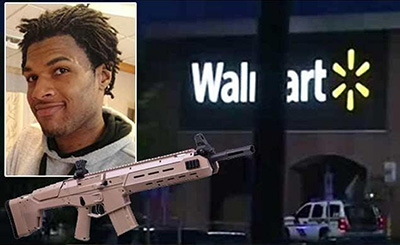
In Beavercreek, Ohio, on August ix, 2014, 22-twelvemonth-sometime John Crawford selected a product from a local Walmart'south shelf, calmly walked toward the shop's checkout area, carrying a toy rifle in i hand and a cell telephone in the other. Crawford was talking to his mother via phone, unaware that ii other shoppers had called 911 to report a man with a gun was in the store. Adrenaline-pumped officers arrived, confronted Crawford and immediately shouted a series of commands that made no sense to a boyfriend simply engaged in a phone conversation. His ostensibly ho-hum compliance prompted constabulary officers to immediately fire several deadly rounds, killing Crawford.
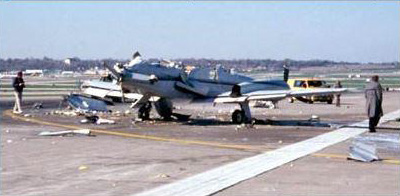
On November 22, 1994, Ralph Peterson, the pilot of a small aircraft, prepared to fly back to his Iron Mountain, Michigan, home. He acknowledged taxi instructions radioed by the Bridgeton, Missouri, airport ground controller, and for reasons unknown, taxied his twin-engine Cessna onto the wrong runway. A TWA commercial airliner, accelerating to takeoff speed on the same runway, struck the Cessna and sheared its top off, instantly killing Peterson and his rider.
Both incidents involved systems dependent on homo factors, and both ended tragically, thanks to poor communication. Both were thoroughly investigated, but the ultimate outcomes were quite dissimilar.
The police force-involved fatality yielded no changes in procedures, perpetuating a arrangement that virtually guaranteed the same blazon of tragedy would happen again. In contrast, the fatal taxiway incident changed aviation forever and contributed to flight becoming the world'due south safest mode of travel.
Why such diametrically opposite outcomes? The answer lies in the two professions' distinctly dissimilar EXTERNAL LEARNING SYSTEMS. In aviation, an independent squad of National Transportation Safety Board (NTSB) experts diligently gathers evidence subsequently an blow, analyzes information and facts, and bug nonbinding recommendations designed to prevent similar incidents from reoccurring. As a issue of the Missouri taxiway accident, the NTSB recommended new protocols be established to amend airplane pilot-controller communications and signage along taxi routes. They even suggested introducing unambiguous terms such equally "back taxi" into radio transmissions, to ensure aviators have a better mind-picture of the airfield surround.
In constabulary enforcement, at that place is no centralized "external learning system" that gathers data and analyzes the facts associated with a mortiferous incident, so issues preventive safety recommendations.
Consequently, Americans are dying at an ever-increasing charge per unit through encounters with police. In 2015, at least 1,209 people were killed by constabulary officers. As of early Nov, 992 people have died this year (killedbypolice.internet). According to PoliceOne.com, it is estimated that roughly 25% of officeholder-involved shootings concern mistake-of-fact scenarios like the Crawford shooting. Indeed, the authors' sons were killed past frightened, amped-upwardly law officers who fabricated deadly mistakes. Those senseless tragedies drove us to become song advocates for systemic improvements in how police force-involved deaths are investigated. Hopefully, these will foreclose future senseless shootings.
As professional person aviators with operational and flight testing experience, we know that aviation's time-proven protocols could save endless lives, if adopted by police departments. Other loftier-hazard sectors—such as medicine, aeriform firefighting, offshore drilling, and electrical utilities—have been down the aforementioned road. Unlike police enforcement, they likewise learned from deadly accidents and developed protocols to determine the cause of fatal incidents. These yielded policies, processes and procedures designed to prevent future fatalities, as opposed to simply finding mistake and affixing arraign.
For example, the U.S. ceremonious space program suffered a massive tragedy on Jan 28, 1986. Space shuttle Challenger saturday on a Florida launch pad that fateful morning time, its external tank and solid rocket boosters sheathed in thick ice. Halfway across the land, a rocket engineer passionately pleaded with his bosses and NASA managers to non launch Challenger. He repeatedly warned that flexible O-rings between sections of the twin solid-fuel boosters could neglect, because they were being exposed to unprecedented low temperatures.
The engineer was ignored, managers gave the "Go" order, main engines and boosters ignited, and, 73 seconds afterwards liftoff, Space Shuttle Challenger exploded, killing seven astronauts.

Subsequently, the Rogers Committee issued a hard-hitting report citing NASA and contractor managers' failure to listen and listen experts' warnings as primal contributors to the disaster. Recommendations from this outside commission ultimately were adopted, significantly improving the shuttle program'due south procedures—and greatly enhancing crewmember safe.
Fast forwards 30 years and compare the Challenger tragedy'southward investigation—and its outcome—with those of nigh officer-involved shootings. NASA and its contractors did non investigate themselves. They empaneled contained experts and gave them full latitude to scrutinize every element related to the space agency'south processes, procedures and practices. Equally a result, the Rogers Commission focused on finding causes for the Challenger accident, every bit opposed to assigning blame and punishing those responsible.
Such an independent, observe-and-fix approach is rare in the law enforcement field. Non only exercise most police force agencies investigate their own officers' actions in deadly situations, the chief purpose of those investigations is to determine whether the officers complied with the law and departmental policies, equally opposed to identifying correctable causes. Even police agencies—such as the New York City Constabulary Department—that generally do a skillful chore of identifying why their officers used deadly force are unable to readily share those lessons with others in the field. A centralized database to shop those lessons, backed by a robust dissemination system, simply do not exist.
Farther, the vast majority of police agencies that investigate themselves almost always finds their officers' use of force justified. Because their written report findings frequently are kept to themselves or shared with a few overseers, no "lessons-learned" are captured or shared—and nothing changes.
Albert Einstein described insanity as "doing the same matter over and over again, and expecting different results." Until police force at all levels take a serious look at how other high-hazard sectors and occupations operate, using a centralized external learning system, they will keep to experience a breakdown of trust and credibility. And Americans—many innocent of whatever misdeed—volition continue to die during encounters with police officers.
The President's Task Force on 21st Century Policing touched on the need for a centralized external learning system in its final study. That document recommends that "Congress should develop and enact peer review mistake-direction legislation. The task force recommends that Congress enact legislation like to the Healthcare Quality Improvement Human action of 1986 that would support the development of an effective peer review error-management organisation for police enforcement similar to what exists in medicine." Such a system would let constabulary enforcement officers to openly and bluntly discuss their own or others' mistakes.
Dorsum to aviation's proven methodologies: Equally the post-obit nautical chart shows, deaths attributed to aircraft accidents have steadily decreased over decades, fifty-fifty though the number of flights has increased to millions per year. Commercial air travel is now the safest manner of transportation in America, primarily because the manufacture focuses on finding and fixing the cause of accidents, rather than on finding fault.
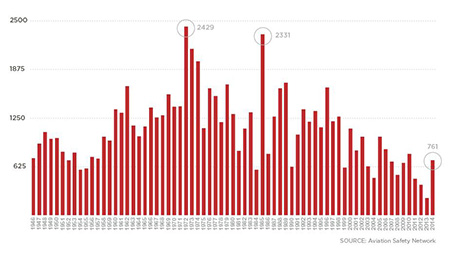
Aviation'southward stunning success in drastically reducing the number of accidents and constantly improving safety is directly related to 3rd-party investigations conducted by the National Transportation Condom Board'south independent experts and overseers. Their focus on identifying causes, rather than mistake-finding, is summarized on the NTSB website (NTSB.org): "Recommendations usually accost a specific issue uncovered during an investigation or study and specify how to right the situation."
The NTSB's "Go Teams" immediately take control of an accident scene, then meticulously search for every single item and cistron that might have contributed to the incident. The investigation focuses on what occurred, and a concluding report issues recommendations for preventing like accidents in the future. These suggestions go to the Federal Aviation Administration, which can accept or decline them. Typically, eighty percent of NTSB recommendations are put into practice.
Yeah, fault may be assigned and criminal or civil liability established. Those are complex determinations that oftentimes need to account for the faulty decisions and actions of both the civilians and police officers involved, and which should, ultimately, be made past lay juries or elected prosecutors. But in peer review error-direction systems, fault-finding is secondary to pinpointing the crusade of a deadly accident and fixing whatsoever contributed to it. Prevention of time to come accidents and continuous comeback are the primary objectives. Investigation findings are captured and logged into a federal Aviation Rubber Database, providing information about all accidents and resulting reforms. Lessons-learned are available to everybody in the aviation manufacture.
Can the NTSB model exist applied to policing? We are convinced it can. A Federal Management Organization for funding and directing statewide peer reviews could and should be established. Independent local or country investigators would handle fact-gathering, while prosecutors would yet command decisions fabricated in the context of criminal constabulary. And, as the NTSB does, information could exist tightly held during the gathering and analysis phases, and then released in the spirit of total transparency via public hearings, available for scrutiny by all interested parties. Embracing these simple measures would build trust and reestablish the legitimacy of today'south law enforcement community.
The lessons of aviation and other time-critical, high-run a risk sectors can and should be adjusted to the police context. Abandoning a myopic focus on error-finding and expanding investigations to identify causes that lead to prevention are essential first steps.
Michael M. Bell and William B. Scott
Michael Thousand. Bell, Lt. Colonel, USAF retired, was a senior command pilot who served in Desert Storm, Bosnia-Kosovo and Afghanistan. His son, Michael, was killed by police on Nov. ix, 2004.
William B. Scott is a former USAF flight exam engineer and retired Aviation Calendar week and Space Technology agency master. His son, Erik, was killed by police on July ten, 2010.
Source: https://michaelbell.info/ChangeTheProcess.html
0 Response to "Congress Should Develop and Enact Peer Review Error Management Legislation"
Post a Comment